Industry · Mining, Quarry & Tooling
Your distributor is explaining your product right now. Without your engineer in the room.
You sell into dozens of countries through partners and distributors. Every one of them has to explain a drilling, cutting or polishing machine to a buyer who has never seen it work. That explanation is where deals slow down. Not the product.
The Problem
The Part That Sells It
Is the Part Nobody Can See
Three reasons the explanation, not the product, is what slows your deals down.
Reach
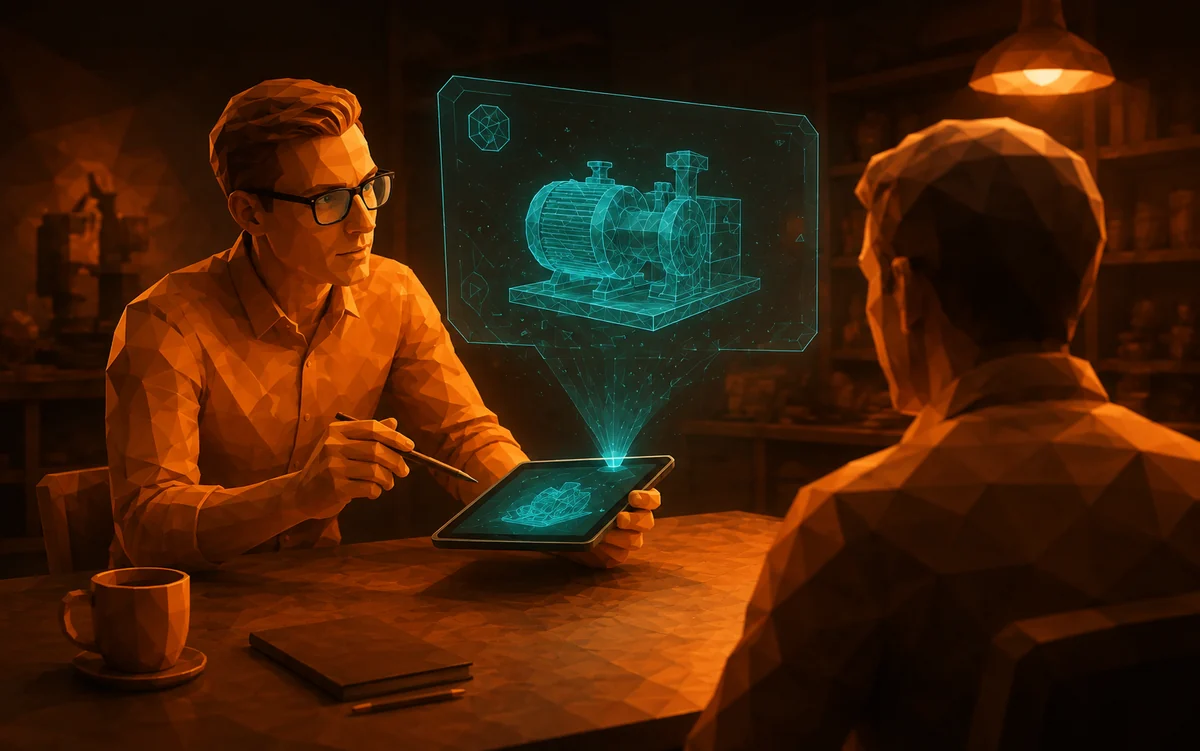
Your engineer does not scale
Your people explain the product on calls, at trade shows, on site. It works, and it stops working the moment the market is one you visit twice a year.
Visibility
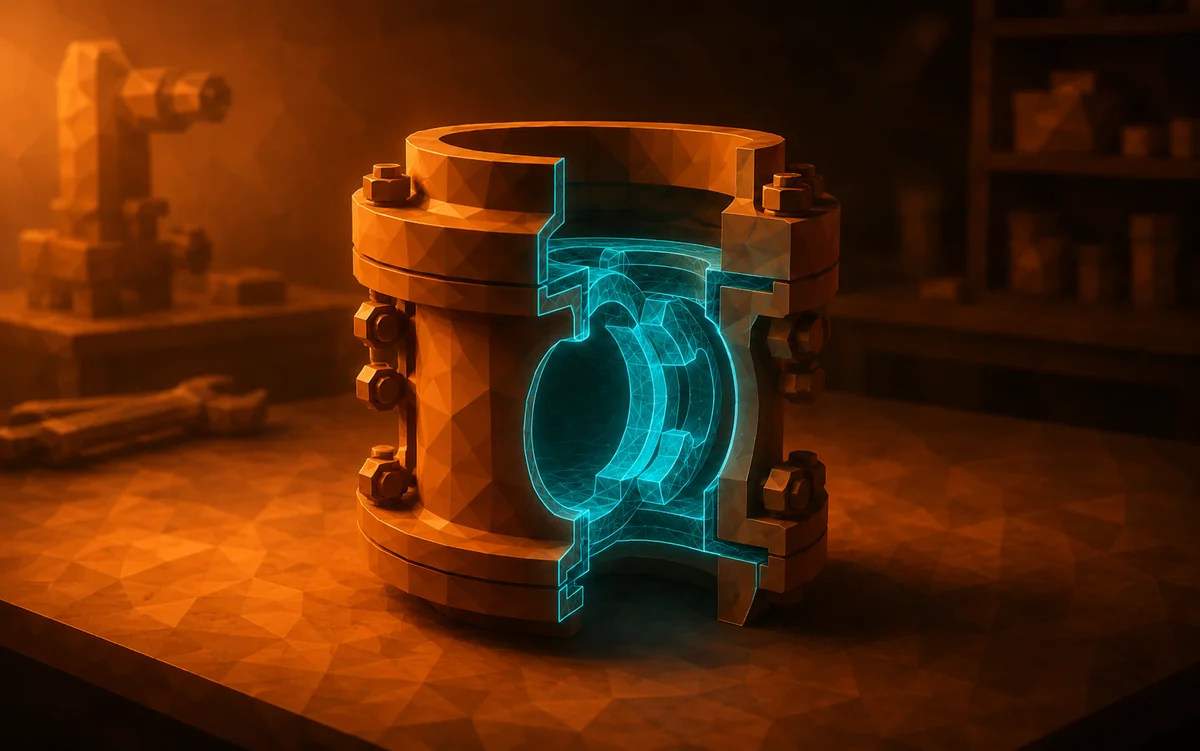
The mechanism is hidden by design
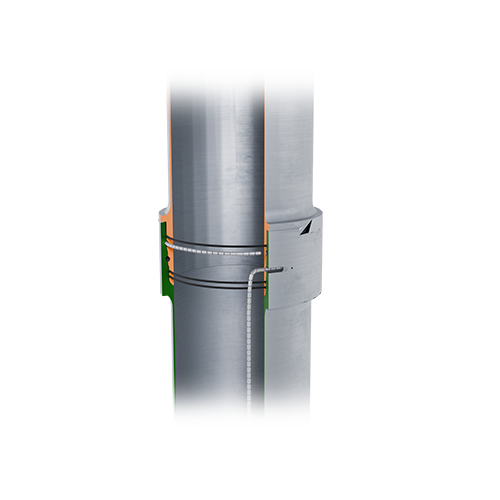
Section drawings ask the buyer to assemble the movement in his head. A 3D model does that work for him, in the browser, in about fifteen seconds.
Proof
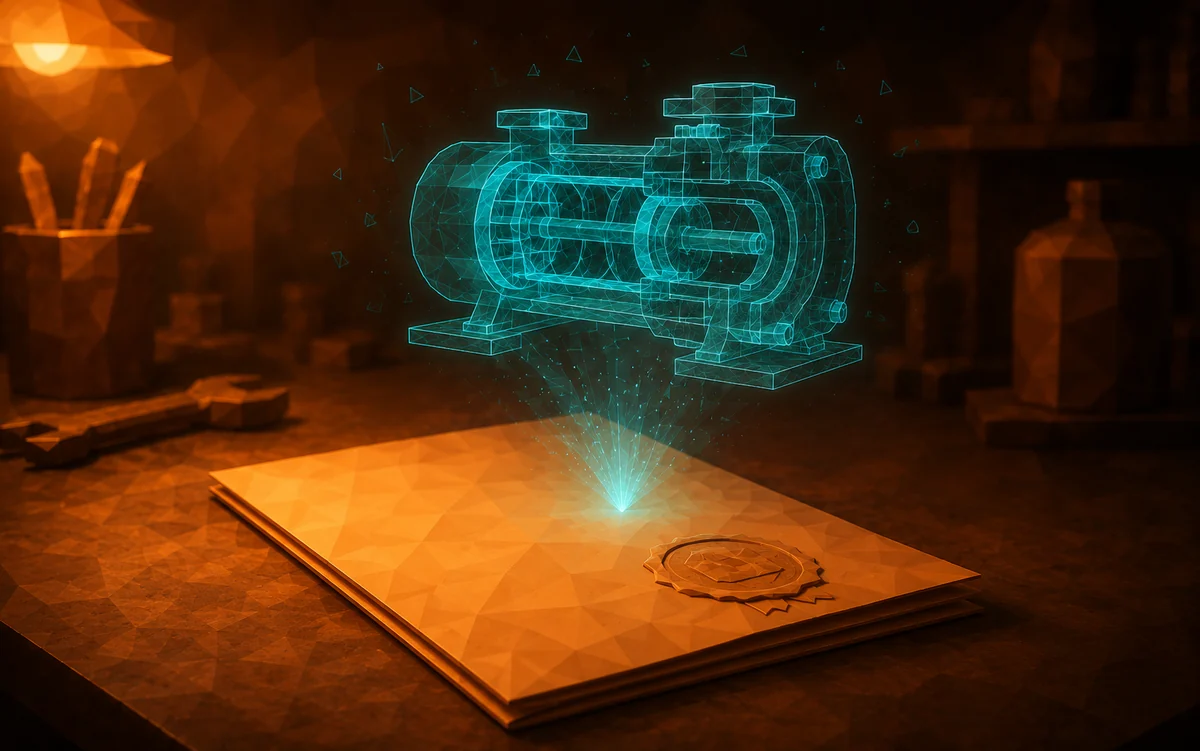
A certificate states it. It cannot show it.
Uptime shows months later, safety hopefully never, and what a CE or ATEX rating constrains sits in materials, clearances and surface temperature. What can be shown in the meeting is the build behind those promises.
Live in Your Browser
The Mechanism, Running,
With Nothing to Read
The joint closes and releases on its own, in your browser, without a click. Turn it while it runs and look at it from the side no section drawing shows.
One Data Source
Five Ways to Sell With the Same CAD File
The player above and everything below it come from one source file. Prepared once, used in the browser, in the meeting, on the phone and on the client's own website.
In the browser, on any device, no app, no login.

The identical movement as a video for presentations and trade show screens.

The whole path: QR code on the roll-up, part standing in the room seconds later.
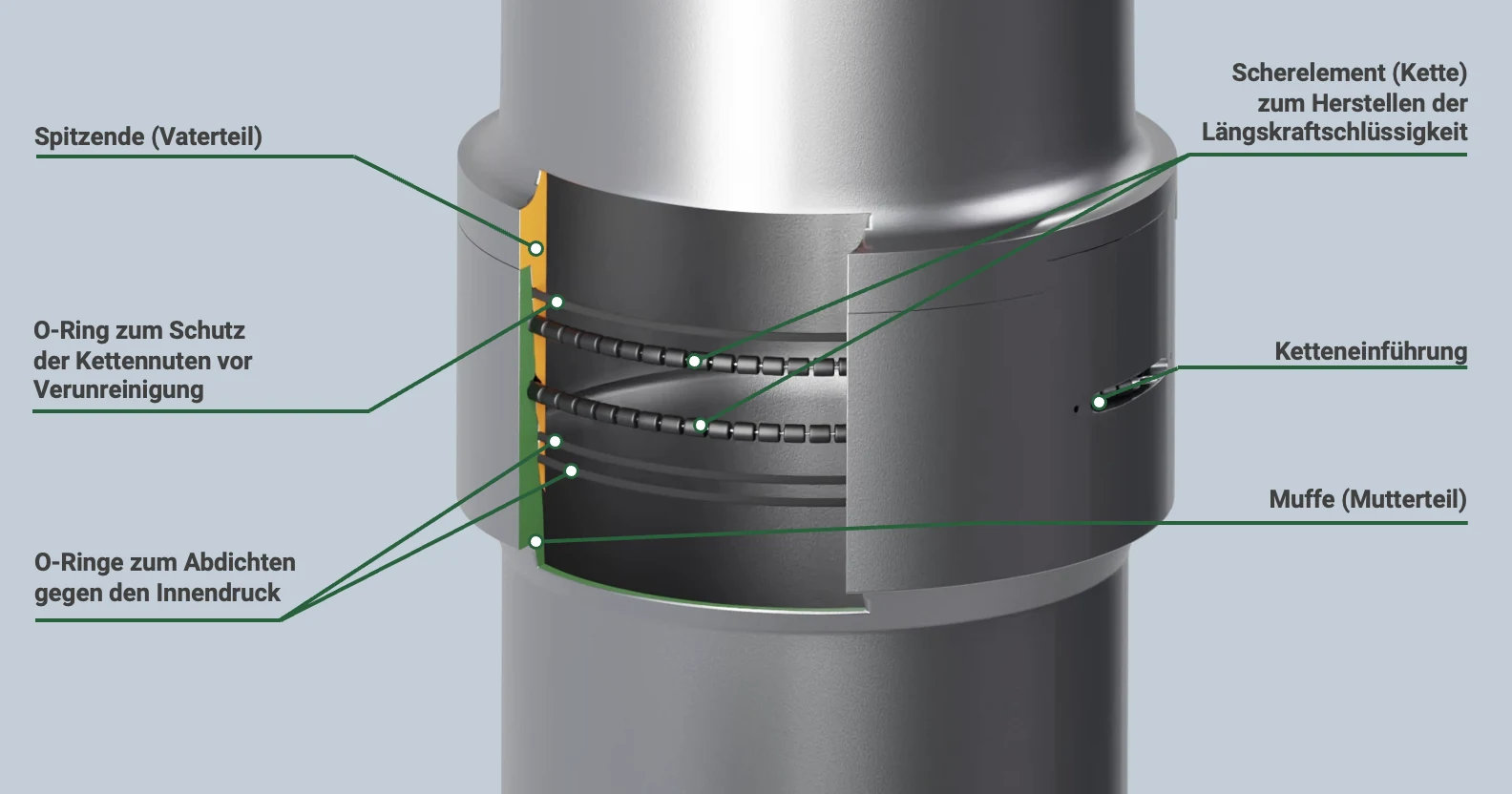
The same source, driven by the scroll position of their own product page. See it running on carl-hamm.com

Mostly real VR180 camera footage from the plant, with one animated sequence built from the same CAD source and rendered in the same VR180 format. The customer walks the plant instead of flying to it.
Five outputs, one CAD file. Even the factory tour carries it, in an animated VR180 sequence built from the same source. When the part changes, the source changes once and every output follows.
Case · Carl Hamm
A Coupling That Works Where Nobody Can Look
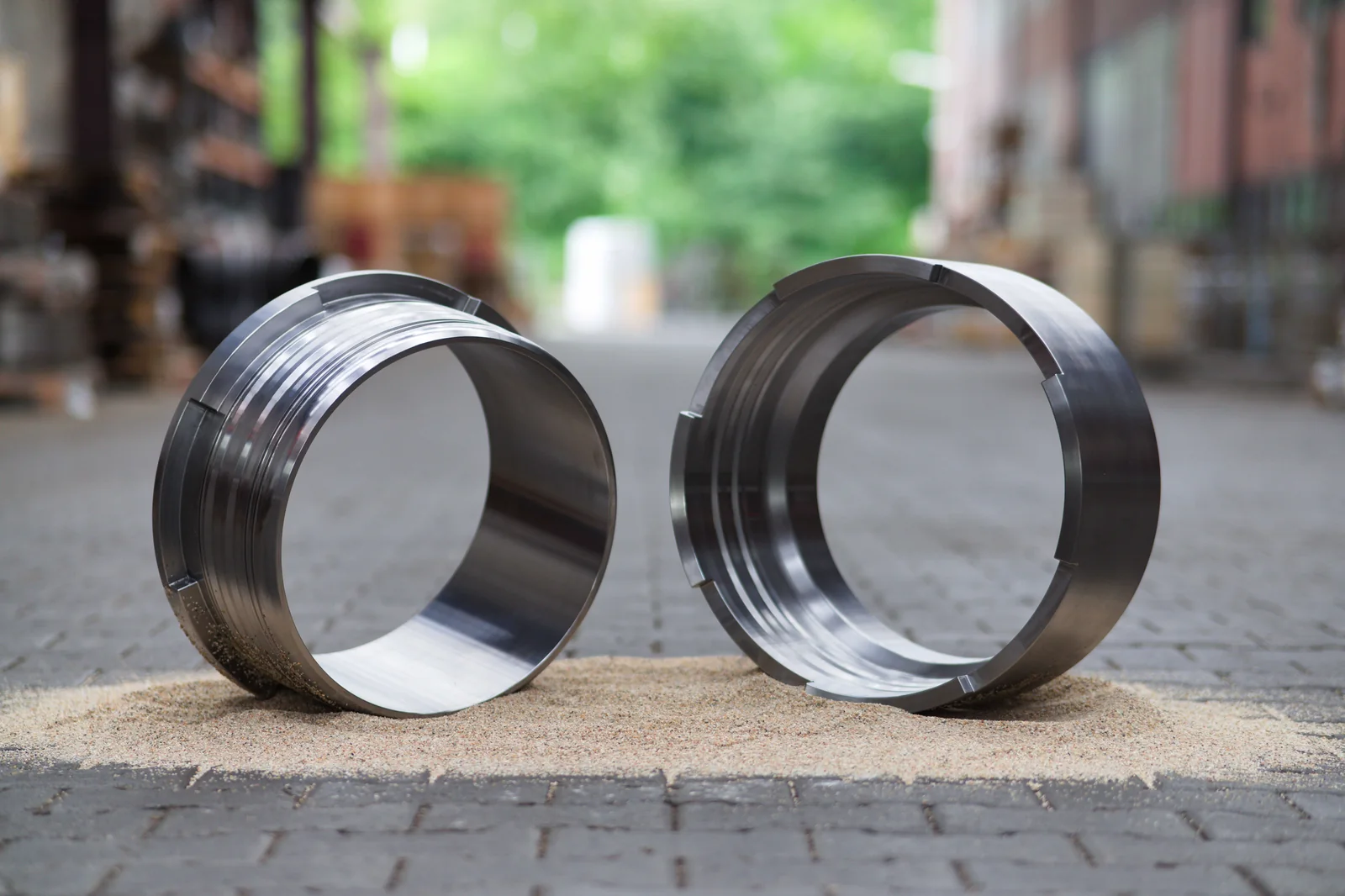
Carl Hamm builds pipe systems with a patented locking coupling for shaft lines in underground mining and for deep well construction. The part that makes it worth buying sits inside the joint and does its work out of sight. For years the sales team explained that in words and section drawings.
DN 50 to DN 800 pressure rated, casing pipe up to DN 1400
Up to PN 400, depending on size
Axial loads up to 1,800 tonnes at breaking point
Pipe lengths up to 16 m, steel, stainless, duplex and superduplex
Figures published by the manufacturer.
We built the mechanism as a 3D animation straight from the CAD data, then reused the same source for augmented reality on a phone, for an interactive presentation with around 400 non linear slides, for the scroll animation on their own product page and for a VR180 factory tour.
The first project ran through sales. The website came later, as a separate assignment.
More From This Field
Mining Operators and Confidential Work

K+S · Mining Operator
It started in HR. Sales took it over.
One of Germany's large mining groups commissioned 360 degree tours to show applicants what a workplace underground actually looks like. The sales side saw the material and wanted its own version.
In the follow up project we rebuilt a section of tunnel as a 3D model so a blast could be experienced rather than described, and that scene went back into the 360 degree video the field team uses. Today a sales engineer carries the experience to the customer instead of describing the site. That part is experienced on site with the field team, not on a website. What we can show here is the 360 degree work it grew out of.
Videos and the written case
Under NDA
Two of the projects closest to your world cannot appear on this page. Here is what we can say about them.
ATEX certified machine manufacturer
Equipment built for explosive atmospheres, where a demonstration on a live site is restricted by the same directive that governs the product. The models do the demonstrating instead.
German gas & hydrogen network operator
Here the constraints are not only technical but legal. What may be shown, to whom, and in what form is part of the brief from the first day.
Neither is named, described in detail, or hinted at anywhere else. If your products carry the same requirement, the same applies to you.
How This Works
You Buy Assets, Not a Licence.
There is no software to license and no seat to pay for. We build assets from your CAD data and they belong to you. We start with one pilot, and what happens after it is a decision you make, not a condition of buying.
The pilot. One product, prepared from data you already have. No filming, no travel, no licence.
Then, path one: your team takes over. We train your people to do this work in house, in full or in the part that repeats.
Or path two: we stay alongside. Some clients keep us on a fixed term retainer while their people learn the work. Others hand us a small share of the preparation for good. Your call, either way.
Either way, the goal is the same. You end up with digital twin ready 3D assets that your sales people actually use, not a folder of renderings.
Evidence
This Is Measured, Not Claimed
Extended reality raises customer loyalty and upselling through co created mental imagery: buyer and seller build the same picture of the product, which raises confidence in the decision. The effect is strongest for complex, tactile products such as machines, systems and installations.
The same study finds that XR supported remote meetings perform as well as presentations held on site. For a manufacturer selling through partners in other countries, that is the practical part.
A second study measured how hard a choice feels. Static AR, a clear view without constant motion, lowered the perceived difficulty of a choice more than physical samples did, and using both in sequence, sample first and model second, worked better still. For a manufacturer with a large accessory range that is the practical point: the sample case your distributor carries stays useful, the model covers everything that does not fit in it.
Ven, Doucé, Willems, Rademakers, Brengman and Loupiac (2025), Electronic Markets 35, Article 54.
→ Our write up on the Journal of Marketing study
→ How we define OpenUSD, WebAR and the other terms on this page
Confidentiality
Most of What We Build Never Goes Public. By Design.
We work under NDA for manufacturers and operators whose products are not public. Those projects are not listed here, not described here, and not hinted at. If your products carry the same requirement, the same applies to you.
- Collaboration on an NDA basis, data is accepted only after agreement.
- Abstracted models: geometry is transformed so the IP cannot be reconstructed, while the mechanism is still presented convincingly.
- Delivery on request as sealed files, fully offline and on premise. No cloud requirement.
- Clear data sovereignty: source data stays with you.
Send Us One Product
Write to Gerhard Schröder, managing director of viSales, and name one product you would want your distributors to explain better. You get an honest answer on what would be worth doing with it and what would not.
sales@visales.deWe answer within one business day and arrange a call by email.
Frequently Asked Questions
What do mining and quarry equipment manufacturers use 3D and AR for?
To let a distributor explain a mechanism he has never seen opened. The buying argument for drilling systems, couplings and pneumatic tooling sits inside the product, where a photo cannot go and a section drawing asks too much of the reader.
We already have CAD data. What happens to it?
It is reduced and prepared for sales use, not re-modelled. The result is an OpenUSD master file. From that one source come the interactive player, the animation, the AR model, web elements and configurator variants. Your original data stays with you.
What does an asset like the player on this page cost?
The honest answer is that the question is worth turning around first. One prepared model is not one deliverable: the same ZSM source on this page runs as an interactive player, as a 16:9 animation, as an AR session and as a scroll animation on the client's own website.
As a guideline, preparing one product takes two to six working days, which puts it between roughly 2,000 and 4,500 euros. That covers the prepared source and the outputs that come straight out of it: the player, the AR version, the animation and a web element. Filming on location is separate work, as in the VR180 tour above, but even there the animated sequence inside the footage comes from the same prepared source. Where you land in the range depends on the state of your source data: clean, complete CAD is at the fast end, a fragment that has to be rebuilt is at the other.
We are happy to prepare a short demo from your own data and walk you through it on a call, so you see what your data can carry before anyone talks about scope.
Our product is confidential. Can you still work with it?
Yes. NDA in advance, abstracted models where the geometry is sensitive, sealed files, on premise and offline delivery available. We have references in this mode that we do not name, which is the point of them.
What is OpenUSD and why does it matter here?
OpenUSD is an open 3D standard backed by Apple, NVIDIA, Pixar and the Alliance for OpenUSD. One data source delivers every output format, from AR through rendering to web, without platform lock-in and without duplicate pipelines. viSales is a member of the Alliance for OpenUSD.
On which devices do the AR models run?
iPhone, iPad and Apple Vision Pro through Quick Look, Android through Scene Viewer in the browser, desktop through a QR code. No app store, no login.
When is this not worth doing?
When the product is simple. The Journal of Marketing study is explicit about it: the effect is strongest for complex, tactile products such as machines, systems and installations, and clearly weaker for simple ones. If a buyer understands your product from a photo, a photo is the right tool and this is unnecessary effort.
The same study names a second limit that we take seriously. Sales people who use this kind of tool once a quarter and then have to improvise in front of a customer report more role stress, not less. It pays off where it becomes normal equipment, not where it is brought out for special occasions. That is one reason we start with a pilot instead of a rollout.
→ Our write up on the study, including its limits (German)
How long until our sales team can actually use it?
The work on one product is two to six working days, depending on the state of your source data. In practice, plan one to two weeks from the moment we have the data, which covers your feedback round and the small corrections that always come with the first product. After that it gets faster: every further output from the same source, the animation, the AR version, the web element, is a matter of days rather than weeks, because the model itself does not have to be built again.
Who owns the assets, and can our own team take them over later?
You own them. The assets are built from your CAD data and delivered to you, and the OpenUSD source is an open standard, so nothing is locked to a tool of ours. If you want the work in house, we train your team to do it, in full or in the part that repeats. That is a normal outcome for us, not a lost customer: the goal is that you end up with digital twin ready 3D assets your sales people use every week.